| Studio Name: | Slapshot |
| Year founded: | 2020 |
| Headquarter: | New Hampshire, USA |
| Services offered: | AI powered VFX toolkit |
| Interview given by: | Varun Parange (Co-Founder, CTO & Head of Product @ Slapshot) |
Artificial Intelligence is rapidly reshaping visual effects production, but one question continues to dominate the industry: Can AI genuinely help artists without replacing them?
Slapshot believes the answer lies in building AI that removes repetitive work while leaving creative decisions firmly in the hands of artists. Founded by experienced VFX professionals, the company has developed an AI-powered VFX automation toolkit that automates labor-intensive tasks such as rotoscoping, camera tracking, depth maps, and motion vectors for productions ranging from independent creators to Academy Award-nominated films.
In this edition of Studio Spotlight, we spoke with Mr. Varun Parange about the company’s journey, the future of AI in visual effects, and why they believe artists and AI will achieve more together than either could alone.
The story behind Slapshot
Slapshot was created by experienced VFX professionals to solve real production challenges using AI. How did this idea get seeded?
Slapshot is an AI-powered VFX toolkit. We take the most labor-intensive parts of visual effects production, the work that traditionally eats up thousands of artist hours, and use AI to lessen the load.
We built it because we’ve lived with the problem. In fact, we built Slapshot first for our own pipeline. Slapshot started as a tool to assist our artists in their work. We watched incredibly talented people spend enormous amounts of time on repetitive, mechanical tasks like masking objects frame by frame. That work is essential and it’s expensive. It’s one of the biggest bottlenecks to making high-end VFX faster and more affordable.
Building it inside our own workflow first meant every feature had to earn its place against a real artist’s daily workflow before it ever reached a customer.
Why Slapshot builds AI for VFX Artists?
Slapshot focuses specifically on professional VFX workflows. How do you combine AI tools with production artists in mind?
The key is that we don’t try to replace the artist’s judgment, we try to remove the manual labor around it. Every tool is designed to output in the formats and to the standards a real pipeline demands: clean hard and soft mattes in EXRs, camera solves that drop straight into Nuke or After Effects for example.
We also keep the artist in control, they choose what to isolate, they review, they refine.
Every output from Slapshot may not be production ready, however many outputs often are. We see a wide spectrum of usage on Slapshot – from final ready outputs, to temps and postvis use cases.
What makes Slapshot different?
How would you describe Slapshot to someone discovering your company for the first time?
The simplest way to put it: Slapshot is AI that does the heavy lifting in visual effects so artists can focus on the art.
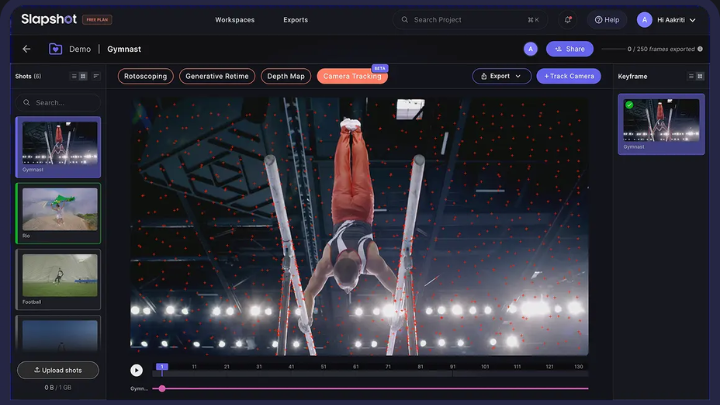
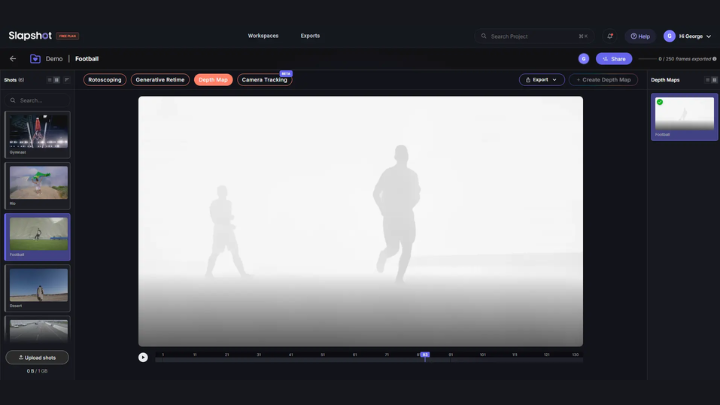
You upload your footage and our AI gets to work. Our AI include AI Rotoscoping, Camera Tracking, Depth Maps and Motion Vectors. We’re built by VFX people for VFX people, but we’ve made it accessible enough that a solo creator and a major studio can gain value from the same tools.
Slapshot’s most popular AI tool
Your platform now offers tools such as AI roto, camera tracking, depth maps, motion vectors, and generative retiming. Which of these has had the biggest impact on artists and studios so far, and why?
Our rotoscoping tool is the most popular tool on Slapshot.
We are proud of the work we put in to build our Roto AI tool – and it is arguably the best one in the market today. Roto is the single most time-consuming task in the pipeline. It’s also the most universal task, nearly every kind of VFX work needs mattes.
Our mattes are of great quality and have a high level of temporal consistency across a wide range of shots. It doesn’t work all the time of course, but does great in many instances.
“AI is here to assist artists, not replace them.”
Solving high-end production challenges
Can you share an example where Slapshot significantly reduced production time or helped solve a particularly difficult VFX challenge for a customer?
Slapshot is being used across an enormous range of projects from Academy Award-nominated films and big-budget streaming shows to mega immersive experiences.
One we’re especially proud of, though we can’t name it, was a large production for one of the biggest immersive experiences in the world. Time was running out and the production company needed rotoscoping on a large number of shots within days. We scaled up the GPU allocation on our infrastructure to support them, and their team ran hundreds of shots through Slapshot and got the outputs they needed comfortably within their timeline.
What made it even more demanding was the footage itself. The immersive experience content is at an extremely high resolution, the format is purpose-built and Slapshot held up at that scale, which is exactly where a lot of tools fall over. Turning that volume of ultra-high-res roto around in days, rather than weeks, was the difference between the production making its deadline or not.
Who Uses your AI for VFX automation software?
What kind of customers use Slapshot?
Today we have more than 9000 users across 80+ countries using Slapshot.
It’s a wide spectrum of users, which is exactly what we hoped for. On one end, we have major studios that have used Slapshot on Academy Award Nominated films. On the other end, we have independent editors, colorists, content creators, people making music videos, short films, and branded content who now have access to tools that used to be locked behind a studio’s budget.
The same engine serves an Oscar-caliber studio and a solo creator working from a laptop.
Can AI replace VFX artists?
Many artists worry that AI may replace creative professionals. How do you respond to it?
I understand the worry, but I see it differently. AI is here to assist artists, not replace them. To take the repetitive, mechanical work off their plate so they can focus on the most creative parts of the job.
And there’s a fundamental limit worth remembering: AI doesn’t create genuinely new things. It learns from what already exists – from the past. It can’t originate a vision, make a creative judgment, or know what a director is reaching for. That’s the artist’s domain, and it isn’t going anywhere. What AI can do is make the work around that creativity dramatically more efficient.
So the way we think about it is – these are tools. Powerful ones, but tools. In the right hands, they let artists do more, take on more ambitious work and spend their time where it truly matters. We built Slapshot inside our own studio, for our own artists the last thing we’d ever do is build something to put them out of work.
“The artists who embrace these tools aren’t going to be replaced by them.”
One AI Engine, multiple creative workflows
Your users include VFX studios, production companies, advertising agencies, editors, and independent creators. How do you balance the needs of such diverse creative professionals?
We think about it as one engine, many doors. The underlying AI is the same whether you’re a mega-scale studio or an editor working solo, everyone benefits from faster, cleaner results. Where they differ is in how they want to access it.
So we meet each group where they are: Slapshot Web for creators who want a simple upload-and-go platform; Slapshot’s API, for studios that need to wire automation directly into an existing pipeline at scale; and integrations with tools like ComfyUI for people who live inside a particular workflow. The core promise is identical for everyone, the product surface flexes to fit the user.
Building AI VFX tool that artists can trust
What has been the biggest technical challenge in building AI tools that artists can actually trust in a production pipeline?
Honestly, the challenge is as much about mindset as it is about technology. AI tools are still in their infancy and they’re getting better every day. And a production pipeline is traditionally a conservative place: a new tool only gets adopted once it’s mature and does the job almost 100% of the time. Every AI tool has to fight against that tide.
Our view is that it’s the wrong question to ask. It isn’t “why doesn’t this tool work for everything, at 100% quality?” It’s “where will this tool make the most impact?” and often that’s a well-defined subset of a task rather than the whole thing. On a big production, automating even the most menial, repetitive part of the work delivers an enormous return, because that’s exactly where the hours pile up.
The encouraging thing is that studios are becoming far more exploratory. They’re reaching for AI tools more and more, testing where they fit, and discovering that a tool doesn’t have to be perfect at everything to be genuinely valuable.
When does an AI tool becomes production ready?
AI tools evolve incredibly fast. How does your team decide when a feature is production-ready instead of simply being an interesting technology demo?
A feature isn’t production-ready when it looks good in a controlled example, it’s ready when our own artists will choose it over their existing manual method on a real world task. Artists on a deadline have zero patience for a tool that creates more work than it saves.
We test our tools internally first – and validate that those tools add value to our artists. Only then do we ship the feature and open it up for everyone.
The future pipeline
What are your future plans for Slapshot?
A big focus right now is integrations – making Slapshot effortless to drop into the tools our clients already use. We’re building an integration with ComfyUI, which we plan to release by the end of this month, and we’ll keep developing more so that Slapshot fits naturally into any client’s pipeline rather than asking them to change how they work.
The goal is simple: meet artists where they already are.
Hiring people who respect the craft
As your team grows, what kind of people are you looking to bring on board? Beyond technical expertise, what qualities make someone a great fit for Slapshot?
Technically, we’re looking for people excited about the intersection of AI and video – computer vision, machine learning, graphics, and the engineering to make all of it fast and reliable at scale. But beyond the technical, the thing we care about most is respect for the craft.
We’re building tools for artists, and the people who thrive here are the ones who genuinely care about the end user’s work. We value curiosity, and a bias toward shipping something real over admiring a prototype. And because we come from a production background, we love people who understand how creative work actually gets made.
If you care about giving artists their time back, you’ll fit right in.
Advice for artists in the AI era
What advice would you give to artists who want to build careers where AI becomes part of their workflow rather than something they fear?
Lean in early, and get experimenting. The artists who will thrive are the ones who treat AI as another instrument in their kit and something to master, not something to guard against.
First, learn where these tools are genuinely good and where they’re not. A lot of the value is simply in knowing when to reach for them. Second, use the time they free up to go deeper on the craft – the taste, the storytelling, the creative judgment no model has. That’s what makes you valuable, and it’s exactly what AI can’t do. Third, stay adaptable, because the tools will keep changing. The real skill is a willingness to keep learning.
The artists who pair strong fundamentals with fluency in these tools won’t be replaced by AI. They’ll outpace the ones who don’t.
Why some studios still hesitate to adopt AI
Many studios are experimenting with AI but are still hesitant to adopt it in production. What do you think are the biggest misconceptions preventing wider adoption?
The biggest one is all-or-nothing thinking and the belief that an AI tool has to be perfect at the entire task or it isn’t worth adopting. As I said earlier, that’s the wrong bar. The real question is where it makes the biggest impact, even if that’s just one slice of the workflow.
A second misconception is that adopting AI means replacing artists or tearing out your pipeline. In reality, the best results come from AI slotting into the pipeline you already have and handing time back to the same artists. And a third is the trust gap around security and control – “where does my footage go, who gets to see it?” Those are fair concerns, and the answer is to build tools that respect them.
What we find is that once a studio runs a real shot through and sees the time saved without giving anything up, the hesitation tends to fall away fast.
Recognition at the Broadcast Tech Innovation Awards
Slapshot was Highly Commended for Best AI Innovation (Workflow) at the Broadcast Tech Innovation Awards 2025. Please tell us more about it.
It meant a great deal, precisely because it came from within our own industry — the broadcast and post-production world we come from, judged by people who understand how hard these problems actually are.
The Workflow category is about tools that genuinely change how work gets done and that’s exactly what we set out to build. For a young company, having that recognized by our peers was a huge moment of validation.
An award like this helps the wider industry take a serious look, and that matters.
What is Slapshot Vision?
Slapshot recently introduced Slapshot Vision, expanding beyond VFX into structured video intelligence for AI training. What inspired this evolution, and how do you see these two worlds connecting in the future?
It came from a realization about what we’d actually built. To build AI tools for VFX well, Slapshot has to understand video at a deep level – what objects are in a frame, where they sit in 3D space, how they move, how far away they are. That happens to be exactly the understanding that AI systems interacting with the physical world like robotics and autonomous systems need.
We were sitting on an engine that turns raw footage into structured, high-quality spatial and temporal data, which is precisely the kind of training data those systems are starved for.
Slapshot Vision is us pointing that capability at a new problem. The two worlds connect because it’s fundamentally the same core technology – video understanding. VFX is where we proved it and where it earns its keep today; physical AI is where that same understanding becomes foundational infrastructure. Our bet is that whoever truly cracks video understanding for one ends up serving both.
How AI will change the economics of VFX?
The VFX industry continues to face increasing budget pressure while clients expect faster turnaround times. How do you see AI changing the economics of visual effects over the next five years?
Dramatically. The economics of VFX have always been governed by human hours and a huge share of those hours go into repetitive work. As AI absorbs that work, the cost floor for high-end VFX drops, and it drops fast.
Over the next five years I think two things will happen at once. High-end work that used to be feasible only with a big studio and a big budget becomes accessible to far more creators, dropping the barriers to entry. And at the top end, studios reinvest the time they save into more ambition and more iteration, rather than fewer people.
The budget pressure and turnaround demands you mention are exactly why this is inevitable. Clients want more, faster, for less, and the only way to bridge the divide is to automate the parts of the pipeline that don’t need a human. The studios that adopt early will simply be able to do more with the same team.
The future of AI-Powered Filmmaking
Looking ahead, what excites you most about the future of AI-powered filmmaking and post-production?
We’re heading toward a world where a small team, or even a single creator, can realize a vision that would have needed a whole studio just a few years ago. That’s going to unlock an enormous amount of creativity from people who were previously priced out – which is very exciting.
On the post side, I’m excited about workflows becoming almost conversational where the mechanical friction between an artist’s intent and the finished shot keeps shrinking, so more of their time goes to the creative decisions. The tools fade into the background and the storytelling comes forward. That’s the future worth building toward.
Where Slapshot sees itself in five years?
Where do you envision Slapshot in the next five years, and what role do you hope it will play in shaping the future of visual effects?
In five years, I want Slapshot to be the video intelligence layer that a large part of the industry runs on. Quietly powering VFX work through our platform, our API, and integrations with the tools people already use.
More broadly, I hope we’ve helped shift the industry’s mindset, from seeing AI as a threat to resist to seeing it as the tool that gave artists their time. And by then Slapshot Vision should have carried that same video-understanding technology well beyond entertainment.
Artists and AI: Better together
Finally, if you could change one thing about today’s animation, VFX, or AI ecosystem, what would it be and why?
I’d try to change the narrative that it’s AI versus artists. It makes artists defensive about tools that could genuinely help them, and it lets some technologists be careless about the people their tools affect.
The truth sits in the middle: the best outcomes come from artists and AI working together, each doing what it’s best at. If I could flip one thing, it would be to replace that fear with a sense of possibility because the artists who embrace these tools aren’t going to be replaced by them. They’re going to do the best work of their careers.
Key insights
- Slapshot was founded by VFX professionals to solve production bottlenecks.
- The company views AI as a productivity tool rather than a replacement for artists.
- Rotoscoping remains its flagship capability because it’s one of the most time-intensive VFX tasks.
- Slapshot is expanding its video-understanding technology into AI training through Slapshot Vision.
- The company believes the future belongs to artists who combine strong creative fundamentals with AI fluency.
For more details, check out the official website: https://slapshot.ai