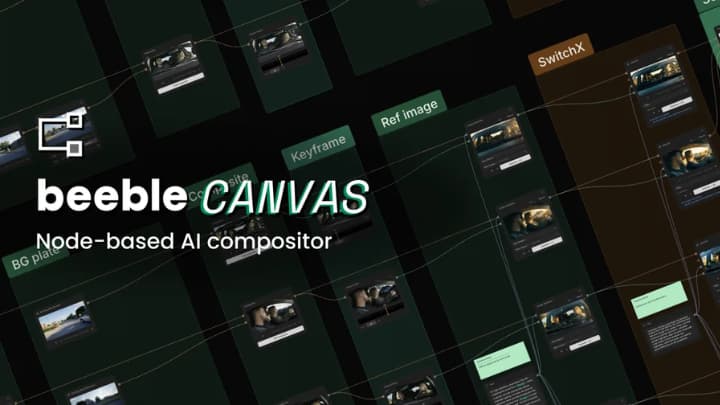
Beeble has launched Canvas as a node-based AI compositing environment built for professional VFX, post-production, and virtual production work. Instead of treating AI as a separate shortcut, Canvas folds generation, rotoscoping, relighting, and traditional compositing into one editable graph. That makes it easier for artists to keep control while still moving faster than a manual-only pipeline.
What stands out is the workflow-first design. Beeble says users can build reusable node graphs, compare variations, and batch process multiple shots without recreating the same setup repeatedly. In a production setting, that matters because the real cost of VFX is often not a single shot, but the time spent repeating the same fixes across many shots.
How Canvas works
Canvas is built around a visual node graph where every element stays editable. Beeble’s own tools sit inside that graph, including SwitchX for video-to-video transformation, SwitchLight for creating physically based rendering passes, and AI rotoscoping tools such as MatAnyone and Corridor Key. The platform also accepts external models, so artists are not locked into one narrow AI stack.
The practical benefit is flexibility. A compositor can import live-action footage, add a matte, generate a relight pass, adjust the background, and then fine-tune the final output in the same environment. Because the graph is modular, the same workflow can be reused for another shot with only minor changes. That is especially useful when a director wants alternate looks, or when a client asks for last-minute revisions.
Real world use cases
One clear use case is green-screen work. A studio could take an interview, music video, or commercial shot, pull a clean key, place the subject into a new environment, and then use AI-assisted relighting to better match the scene. Instead of bouncing between multiple tools, the whole process can stay inside a single production graph.
A second example is complex feature-film cleanup. Suppose a scene has smoke, reflections, and moving light on a character’s face. Canvas can help isolate the actor, generate useful surface passes, and support iterative comp decisions without flattening the work too early. That kind of structure is valuable when a shot changes late in the pipeline, which happens constantly in film and episodic work.
A third example is advertising and social content. Agencies often need one master shot turned into several regional or platform-specific versions with different backgrounds, tones, or product placements. Canvas is useful here because it lets teams branch variations and generate batches rather than repeating the same compositing task from scratch.
Benefits of Canvas in VFX Compositing
Canvas reflects a bigger shift in production software: AI is moving closer to the compositing core instead of sitting on the sidelines. That is important because studios do not just want a flashy output; they want something repeatable, reviewable, and reliable. If a tool cannot be controlled shot by shot, it is difficult to use in serious post-production.
This is where Beeble’s approach feels different. The company is not only offering AI image generation; it is packaging AI into a workflow that already makes sense to VFX artists. That gives Canvas a better chance of being adopted by professionals who care about precision, iteration, and delivery speed. In short, it is less about replacing compositors and more about giving them a smarter pipeline.